


Myopia (nearsightedness) is a refractive error that causes blurred distance vision. It can arise in various ways, primarily because the eye grows more than it should (axial elongation).
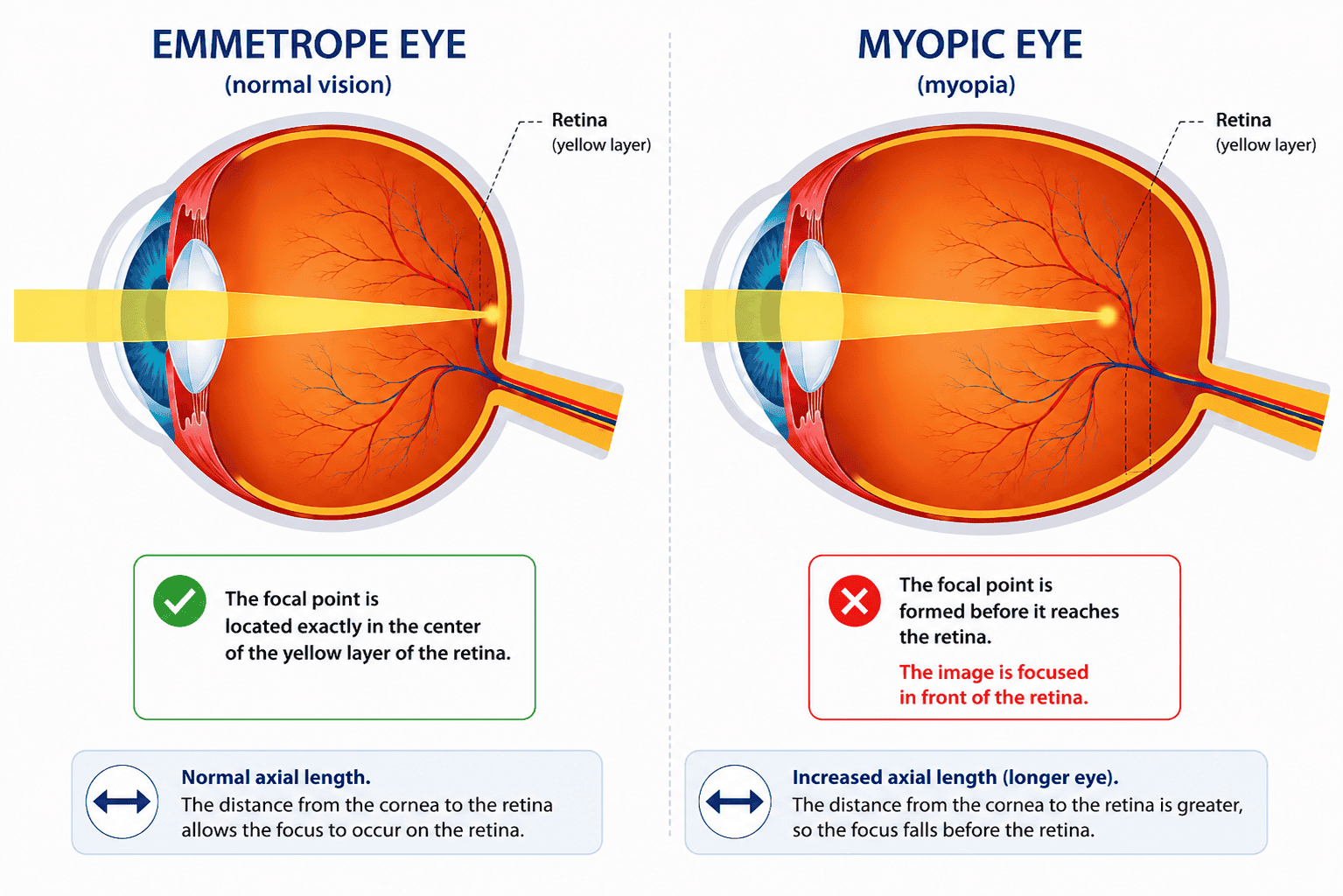
The difference between having and not having myopia
If the eye grows, the myopia worsens. High levels of myopia predispose the eyes to serious complications, such as retinal detachment, glaucoma, and macular degeneration, among others.
Myopia is more likely to progress if it begins in childhood; therefore, this is the most critical period for intervention to halt further eye growth. This is particularly important for children with myopic parents and/or those who spend significant time using screens.
Treatments to prevent the progression of myopia
Every case is different, and a patient might benefit from one or several treatments simultaneously. During the consultation, the best option is determined to ensure a positive patient experience, consistent treatment adherence, and the prevention of myopia progression.
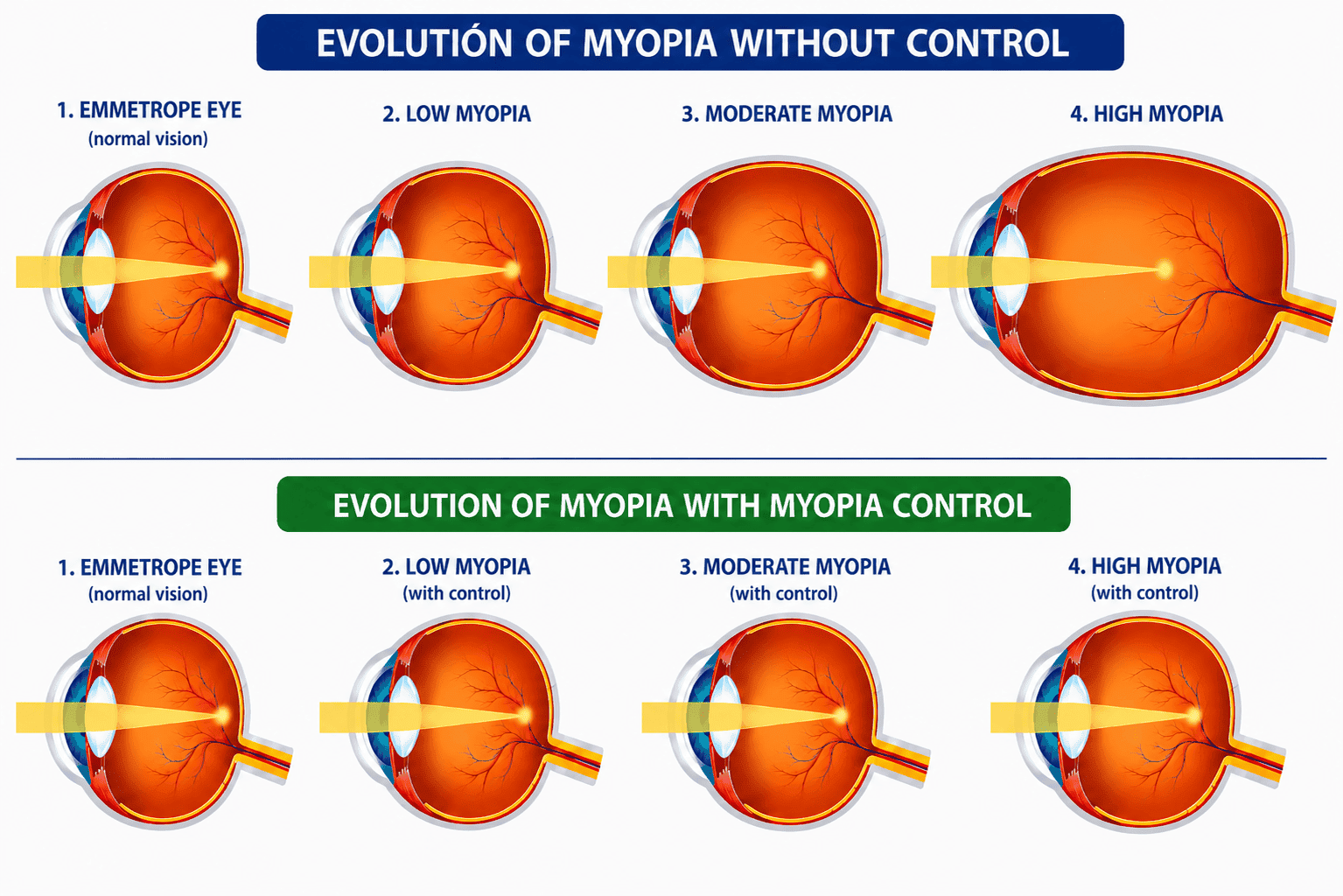
Diagram of myopia progression, with and without treatment
How do we ensure that myopia does not progress?
Beyond measuring the prescription, the best way to monitor myopia is to directly measure the length of the eye; this allows measurements to be compared over time and an accurate record of the myopia to be maintained, while also evaluating the effectiveness of the treatment.
Interested in learning more?
To request more information or schedule an appointment, you can call us by clicking here or write to us by clicking here.

Su privacidad y confianza son muy importantes para ESPECIALIDADES VISUALES a través del Portal de internet www.especialidadesvisuales.com. Por ello, queremos asegurarnos de que conozca cómo salvaguardamos la integridad, privacidad y protección de sus datos personales, en apego a la Ley Federal de Protección de Datos Personales en posesión de Particulares, publicada en el Diario Oficial de la Federación el día 5 de julio de 2010.
Para ESPECIALIDADES VISUALES, resulta necesaria la recopilación de ciertos datos personales para llevar a cabo las actividades intrínsecas a su giro comercial. ESPECIALIDADES VISUALES, tiene la obligación legal y social de cumplir con las medidas, legales y de seguridad suficientes para proteger aquellos datos personales que haya recabado para las finalidades que en el presente aviso de privacidad serán descritas.
Para los efectos del presente Aviso de Privacidad, los Servicios comprenden, de manera enunciativa, más no limitativa, la realización de las siguientes actividades a cargo de ESPECIALIDADES VISUALES ya sea directamente o a través de sus agentes, promotores, comisionistas o socios comerciales
a) Servicios de desarrollo de sistemas, diseño gráfico, impresión y venta de equipo de cómputo.
b) Promoción y venta de otros servicios o productos, incluyendo el procesamiento de reservaciones, subcontratación de servicios con proveedores, así como la facturación, entrega y cobro.
c) La creación e implementación de procesos analíticos y estadísticos relacionados con los Servicios.
d) La realización de cualquier actividad complementaria o auxiliar a los Servicios.
e) Hacer consultas, investigaciones y revisiones en relación a quejas o reclamaciones.
f) Contactarlo para cualquier tema relacionado a los Servicios.
3. Datos Personales. ESPECIALIDADES VISUALES recabará de usted información (Nombre, correo, teléfono y empresa) necesaria para la adecuada prestación de los Servicios ya sea a través de www.especialidadesvisuales.com directamente o correo electrónico a través de sus agentes, promotores, comisionistas o socios comerciales. Dichos Datos Personales, de manera enunciativa, más no limitativa, incluyen la siguiente información:
a) Datos de identificación: Nombre, correo, teléfono y empresa.
4. Finalidad del Tratamiento de Datos: Los Datos Personales que nos ha proporcionado serán utilizados para la prestación de servicios.
5. Transferencia de Datos: Mediante la aceptación del presente Aviso de Privacidad, ESPECIALIDADES VISUALES queda facultado expresamente para transferir sus Datos Personales en la medida en que unilateralmente así lo considere necesario para la prestación de los Servicios dentro e incluso fuera de la República Mexicana.
ESPECIALIDADES VISUALES se compromete a realizar su mejor esfuerzo para velar porque se cumplan todos los principios legales de protección en torno a la transferencia de sus Datos Personales. De igual forma, manifiesta su compromiso en los mismos términos para que se respete en todo momento, por nosotros, por nuestros socios comerciales y por los terceros contratados por ESPECIALIDADES VISUALES, los términos del presente Aviso De Privacidad.
En este sentido, la aceptación de su parte a los términos del presente aviso de privacidad, autoriza expresamente a ESPECIALIDADES VISUALES para que en la prestación de los Servicios transfiera sus Datos Personales a:
a) Aquellas sociedades que formen parte del grupo económico de ESPECIALIDADES VISUALES, incluyendo empresas subsidiarias y filiales de ESPECIALIDADES VISUALES para la prestación del Servicio contratado con usted.
b) Socios comerciales que operen de forma conjuntamente con ESPECIALIDADES VISUALES alguna Tarjeta; o bien algún tipo de software y cualquier infraestructura informática que sirva como plataforma para la prestación de los Servicios.
c) Aquellos terceros no afiliados, prestadores de servicios auxiliares o complementarios de los Servicios, incluyendo, comisionistas, empresas de procesamiento de datos e impresión de Tarjetas, empresas de envío de material de marketing (impreso o electrónico), empresas de mensajería, seguridad y transporte de valores, agencias de publicidad, proveedores de servicios turísticos (como aerolíneas, hoteles o arrendadoras de autos), proveedores de servicios de entretenimiento, empresas de custodia y guarda de información (física o en medios electrónicos) con el propósito de que estos asistan en la prestación de los Servicios; y
d) Consultores externos para efecto de la administración de cobranza relacionada con los Servicios y para defender a ESPECIALIDADES VISUALES de cualquier controversia legal que surja con motivo de la prestación de los Servicios, tales como agencias de cobranza o auditores externos (legales y contables).
6. Medios para ejercer los derechos. Conforme a la Ley Federal de Protección de Datos Personales en Posesión de Particulares (Ley de Datos), el titular por sí o mediante representante legal debidamente acreditado, podrá ejercer sus derechos de acceso, rectificación, cancelación y oposición directamente ante la Unidad Especial de Atención a la Privacidad.
a) Acceso: Usted podrá solicitar en todo momento conocer qué datos suyos han sido recabados y conserva ESPECIALIDADES VISUALES.
b) Rectificación: En caso de que alguno de sus datos sea inexacto o incompleto podrá solicitar su corrección, debiendo adjuntar la documentación que acredite dicha modificación.
c) Cancelación: Podrá solicitarse en todo momento la cancelación de los datos; en caso de ser procedente la solicitud, los datos entrarán al periodo de bloqueo en el cual no podrán ser tratados de ninguna manera para su posterior supresión.
d) Oposición: En todo momento el titular podrá negarse por causa justificada al tratamiento de sus datos personales. Usted o, en su caso, su representante legal, podrá ejercer los derechos de acceso, rectificación, cancelación y oposición previstos en la Ley de Datos.
6.1. La solicitud de acceso, rectificación, cancelación u oposición enviarse por correo electrónico a la dirección: contacto@binseri.com y acompañar lo siguiente:
I) El nombre del titular y dirección de correo electrónico para comunicarle la respuesta a su solicitud;
II) Los documentos que acrediten la identidad o, en su caso, la representación legal del titular;
lII) Cualquier otro elemento o documento que facilite la localización de los Datos Personales.
6.2. Sólo cuando se cumplan todos y cada uno de los requisitos a que se refiere el inciso inmediato anterior, ESPECIALIDADES VISUALES dará trámite a las solicitudes para el ejercicio de los derechos a que se refiere la Ley de Datos.
6.3. En el caso de solicitudes de rectificación de datos personales, el titular deberá indicar, además de lo señalado anteriormente, las modificaciones a realizarse y aportar la documentación que sustente su petición.
6.4. ESPECIALIDADES VISUALES comunicará al Titular, en un plazo máximo de noventa días naturales, contados desde la fecha en que se recibió la solicitud de acceso, rectificación, cancelación u oposición, la determinación adoptada, a efecto de que, si resulta procedente, se haga efectiva la misma dentro de los quince días hábiles siguientes a la fecha en que se comunica la respuesta. Tratándose de solicitudes de acceso a datos personales, procederá la entrega previa acreditación de la identidad del solicitante o representante legal, según corresponda.
6.5. Los plazos antes referidos podrán ser ampliados una sola vez por un periodo igual, siempre y cuando así lo justifiquen las circunstancias del caso, a criterio de ESPECIALIDADES VISUALES.
6.6. La obligación de acceso a la información se dará por cumplida cuando se pongan a disposición del titular los Datos Personales; o bien, mediante la expedición de copias simples, documentos electrónicos o cualquier otro medio que determine ESPECIALIDADES VISUALES.
6.7. ESPECIALIDADES VISUALES podrá negar el acceso a los datos personales, o a realizar la rectificación o cancelación o conceder la oposición al tratamiento de los mismos, en los siguientes supuestos:
I. Cuando el solicitante no sea el titular de los Datos Personales, o el representante legal no esté debidamente acreditado para ello;
II. Cuando en su base de datos, no se encuentren los Datos Personales de que se trate la solicitud;
III. Cuando se lesionen los derechos de un tercero;
IV. Cuando exista un impedimento legal, o la resolución de una autoridad competente, que restrinja el acceso a los Datos Personales, o no permita la rectificación, cancelación u oposición de los mismos, y
V. Cuando la rectificación, cancelación u oposición haya sido previamente realizada.
6.8. La negativa a que se refiere esta sección podrá ser parcial en cuyo caso ESPECIALIDADES VISUALES efectuará el acceso, rectificación, cancelación u oposición requerida por el titular.
6.9. En todos los casos anteriores, ESPECIALIDADES VISUALES deberá informar el motivo de su decisión y comunicarla al titular, o en su caso, al representante legal, en los plazos establecidos para tal efecto, por el mismo medio por el que se llevó a cabo la solicitud, acompañando, en su caso, los elementos que estime convenientes.
6.10. La entrega de los Datos Personales será gratuita, debiendo cubrir el titular únicamente los gastos justificados de envío o con el costo de reproducción en copias u otros formatos. No obstante, si la misma persona reitera su solicitud en un periodo menor a doce meses, los costos no serán mayores a cinco días de Salario Mínimo General Vigente en el Distrito Federal.
7. Cambios a la Política de Privacidad. Cualquier cambio sustancial o total que se realice a la Política de Privacidad podrá ser realizado por ESPECIALIDADES VISUALES a través de la página www.especialidadesvisuales.com, o mediante correo electrónico a la dirección que para tales efectos mantenga ESPECIALIDADES VISUALES registrada.
8. Unidad Especial de Atención al Público. Teléfono: 68503441, con un horario de atención de Lunes a Viernes de 10:00 a 18:00 hrs.
9. Cambios a este Aviso de Privacidad.
9.1. Ocasionalmente podemos actualizar este Aviso de Privacidad.
9.2. Si se producen cambios importantes en este aviso, lo comunicaremos mediante un aviso destacado en el Sitio.
9.3. Le animamos a revisar periódicamente este Aviso de Privacidad para estar informado acerca de cómo protegemos la información que recopilamos.
10. Jurisdicción. Para la interpretación y cumplimiento del presente contrato, el Titular se somete expresamente a la Jurisdicción de los Tribunales y Leyes competentes del Distrito Federal, renunciando a cualquier otro fuero distinto que por cualquier motivo pudiera corresponderle.
La utilización de cualquier servicio del Portal www.especialidadesvisuales.com, en adelante el Portal, atribuye la condición de Usuario del mismo e implica la aceptación de estos Términos y Condiciones.
El Usuario acepta que la utilización del Portal no implica ningún derecho de propiedad sobre el mismo ni en cualquiera de sus partes, funciones o contenido.
Límite de Responsabilidad.
ESPECIALIDADES VISUALES no garantiza a los Usuarios que las funciones del Portal serán ininterrumpidas, sin errores, libres de virus u otros componentes dañinos, ni garantiza evitar fallos de acceso, conexión, indisponibilidad y/o falta de continuidad del Portal y sus servicios, por lo que la ESPECIALIDADES VISUALES no será responsable de cualquier daño y/o perjuicio al Usuario derivado de lo anterior, así como los originados por el servicio de organización de visitas.
Sólo por el hecho de utilizar el Portal, el Usuario renuncia al derecho de demandar a la ESPECIALIDADES VISUALES por cualquier vía, por la falta de disponibilidad o de continuidad en el funcionamiento del Portal y/o sus servicios.
ESPECIALIDADES VISUALES responderá única y exclusivamente por servicios complementarios que pudiera prestar por sí mismo, tales como desarrollo de sistemas, diseño gráfico e impresión.
Conducta de los Usuarios.
El Usuario se compromete a hacer uso del Portal y sus elementos y servicios conforme a lo establecido en los ordenamientos jurídicos aplicables, en estos Términos y Condiciones de Uso, a la moral y las buenas costumbres, y en respeto del orden público. Se compromete también a utilizar el Portal sin afectar derechos e intereses de la ESPECIALIDADES VISUALES, y de una forma en la que no dañe el Portal, inutilice o deteriore total o parcialmente.
Generales.
El funcionamiento del Portal y sus servicios tiene una duración indefinida y podrán ser suspendidos en cualquier momento por la ESPECIALIDADES VISUALES.
Fecha última actualización 01 de septiembre de 2025.